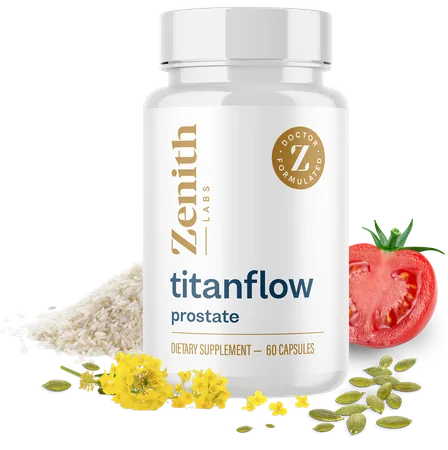
TitanFlow supplement facts: recorded 2025 label
The following quantities come from a TitanFlow label entered in the NIH Dietary Supplement Label Database in March 2025, as reproduced by established label reference services. They are the correct baseline for a label analysis but are not proof that current production batches match the same formulation. NIH DSLD-derived TitanFlow historical label (HelloPharmacist) · Supplement label record (SupLabel)
| Ingredient | Quantity per 2 capsules | Evidence caveat |
|---|---|---|
| Pumpkin seed oil | 500 mg | Oil type and fatty-acid profile matter. |
| Pygeum africanum bark extract | 100 mg | Extract standardization is not established. |
| Broccoli sprout extract | 50 mg | Amount of active breakdown products is not given. |
| Lycopene | 37.5 mg | Form and standardization are unresolved. |
| Beta-sitosterol | 30 mg | Unclear equivalence to researched preparations. |
Other label ingredients: rice flour, silicon dioxide, magnesium stearate and gelatin. People avoiding animal-derived gelatin should take note. The label records 60 capsules and 30 servings per container.
Pumpkin seed oil — 500 mg
Pumpkin seed oil has been investigated for urinary symptoms, but published trials use different products and amounts. A 2021 single-blind trial studied 720 mg/day oil versus tamsulosin in 73 participants; both groups improved, but the medication group showed greater symptom improvement at some time points. The trial had no placebo group. Pumpkin seed oil versus tamsulosin RCT (PMID 34666728)
Separately, the 1,431-person GRANU study found that pumpkin seed extract capsules did not significantly outperform placebo on its primary response endpoint, even though whole-seed findings differed. Whole seeds, extracts and oil are not interchangeable. GRANU pumpkin-seed randomized study (PMID 25196580)
Pygeum africanum bark extract — 100 mg
Pygeum bark has been studied in men with urinary symptoms. A systematic review of 18 randomized trials found favorable signals but also short study durations and trial-method limitations. The type and standardization of the tested extracts matter; TitanFlow's recorded label does not establish equivalence. Pygeum africanum for BPH — systematic review (PMID 11099686)
Broccoli sprout extract — 50 mg
Broccoli sprout research often discusses glucoraphanin and sulforaphane pathways, including biomarkers and laboratory mechanisms. A printed extract mass alone does not tell us the standardized sulforaphane yield. Research involving prostate cancer biomarkers should not be presented as proof of improved urinary flow.
This ingredient's evidence relevance to TitanFlow's specific advertised outcomes remains uncertain; the label does not identify a finished-product trial. Recorded supplement facts
Lycopene — 37.5 mg
Lycopene is a tomato-associated carotenoid studied for a variety of biological effects. Its presence in TitanFlow does not establish a meaningful change in lower urinary tract symptoms or prove a cancer-prevention effect. Earlier marketing references to “5% lycopene” should not be used to calculate an active amount unless the current label or manufacturer documentation confirms the form.
Beta-sitosterol — 30 mg
A Cochrane review of four randomized trials (519 participants) found improvements in some urinary symptoms and flow measures for particular beta-sitosterol preparations. That result cannot be directly projected onto TitanFlow's listed 30 mg, given uncertainty about active purity and formulation. Longer-term outcomes remained unknown. Beta-sitosterols for benign prostatic hyperplasia — Cochrane review (PMID 10796740)
How do the directions describe use?
The recorded label says to take two capsules once daily. It warns not to exceed the recommended dose and to discuss use with a physician, particularly when taking medicines or managing a medical condition. Directions on the physical bottle you receive should take precedence over historical webpages. NIH DSLD-derived TitanFlow historical label (HelloPharmacist)
What the label does not tell us
- Whether each ingredient in current stock matches the 2025 label
- Third-party batch assays for purity and contamination
- Standardized active constituents for all botanical extracts
- Whether the entire formula has been evaluated in a randomized human trial
Sources
- NIH DSLD-derived TitanFlow historical label (HelloPharmacist)
- Supplement label record (SupLabel)
- Pumpkin seed oil versus tamsulosin RCT (PMID 34666728)
- GRANU pumpkin-seed randomized study (PMID 25196580)
- Pygeum africanum for BPH — systematic review (PMID 11099686)
- Beta-sitosterols for benign prostatic hyperplasia — Cochrane review (PMID 10796740)